Are you a couple, adult or teen who is feeling overwhelmed and searching for healing? Therapy can help. I practice Emotionally Focused Therapy and EMDR. Therapy here is secular, but affirming of faith/spiritual practices. All are welcome. Your identity is important.
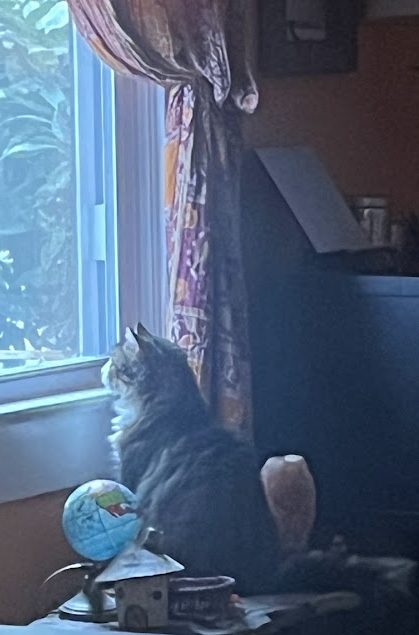
Photo: A lone kitty, sitting beside a globe, gazes out the window. Is he waiting for someone, or something, to return?
I haven’t written here in over one year. I wasn’t away for any particular reason. But now it feels like time to return. I have changed in this time since moving to North Carolina. I think I would like to explore that in some upcoming posts. I am relearning who I am in this new part of my life. In the past two years, just after moving here, I found out I had cancer. The surgery and radiation are over and I am doing well. Another new thing is menopause. Wow–that is a powerful force! Family relationships have shifted and grown. My career has changed, as I am now at an agency in NC as well as maintaining Growing Connections Counseling on a smaller scale. Lots of changes.
I am happy to be here again and would like to share with you. Maybe something will resonate with you. Maybe you will reach out to me, too.
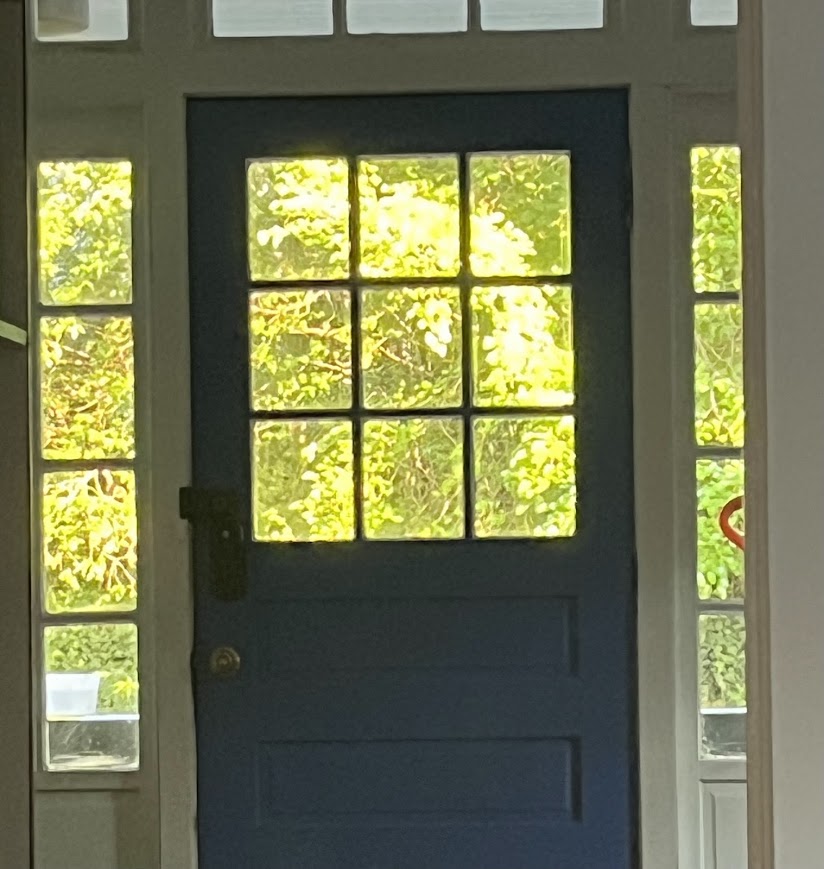
This is the interior view of my front door. I took this photo because all I could see from where I was sitting, was trees. I love that. However, it is not an accurate representation of what is actually outside my front door. It is an illusion. Rather, outside is a concrete retaining wall that has trees and bushes and vines growing all over it. I think it is lovely. But it is not as it appears from my position inside the house.
Much can be said about doorways and perspective. Doors as portals. Closed doors and safety or inhibition. Open doors as opportunity or vulnerability.
Today, though, this photo has me thinking about one’s surety of one’s own perspective as truth. If I were to remain sitting on the couch where I took the photo, I would be sure that I lived in a forest. If I went to the window, I might believe that while I am on a street with other homes, surely I am across from a forest, or at least a woodsy yard.
But if I open the door, if I cross the threshold, I could open my perspective. I could hear traffic–surely this is not a forest! But what? If I go through the door, cross the street, touch the wall, I would learn where I am. I would have entered an adventurous world and be ready for growth and learning!
But if I stay on the couch, resting in my singular untested perspective, it will be harder to learn. I may feel betrayed when the leaves fall and I find that I live near a wall and not a forest. Or, someone may tell me of the wall and I would not believe them.
There is so much to learn! So much adventurous growth that is possible! It requires movement. Move toward the door–one step at a time. Cross the threshold! The world awaits!
What threshold is waiting for you to approach and cross?
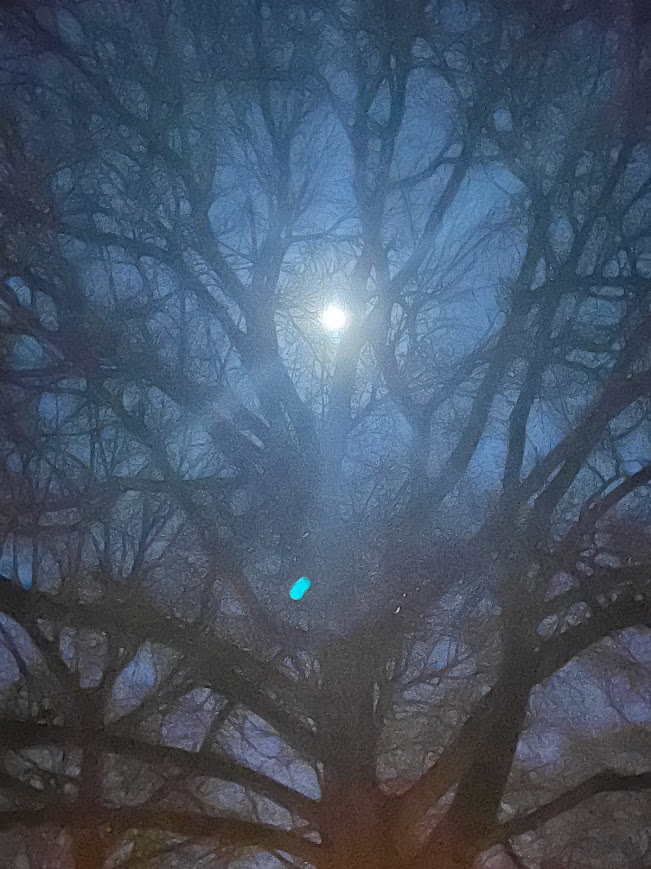
I chose this photo because of the gentle light of the moon–a soft guide, rather than the harsh glare of the sun.
Are there benefits to being hard on yourself? Yesterday, I was watching a documentary and a person was being somewhat praised for being hard on herself.
I don’t think there is benefit in it. I do think there is benefit in holding yourself accountable. But that has an end point. It does not bleed over into shaming yourself. Being compassionate with yourself means learning your reasons for your behavior and finding the strengths you have so you can use them for improvement. Self compassion means being emotionally safe in yourself so you have the strength to overcome challenges. Being hard on yourself takes away energy and can lead to feeling stuck.
Be curious about yourself and your reasons for your behaviors. Curiosity and compassion are more motivational for a longer time.
Photo of the week: Red leaf in my backyard. I chose this photo today mainly because it was in my own yard.
For many of us, it is easy to feel overwhelmed by bad news–personal, as well as global. It can leave us feeling powerless, hopeless, sad, angry. When we are in that headspace, it can be difficult to function in our everyday lives.
One thing that helps me is to find a space where I can make an impact. There are so many important issues that I care about. At the same time, there are only a few that I feel adequately prepared to do something about. These are spaces where I feel knowledgeable and motivated. For me, one of those spaces is the topic of mental health. Another issue is access to mental health resources. So, I offer sliding scale mental health services and free presentations to organizations.
The first step is identifying what issues move you, then finding what you are skilled at. The third step, though, is noticing that you are having an effect. Some of us discount the impact we make in the lives of others. It is important to be aware that, even if we were the most powerful person in the world, our impact on individuals and issues would still be limited. The impact you make may seem small, but it is important. We must not discount that.
The photo of the week is from my yard. I chose this photo because it is a representation of the idea that I may only have impact in my small circle–my “yard”–but it is still an impact. Being intentional with my actions, noticing there is impact on issues I care about, helps me ward off feeling overwhelmed.
What helps you when you feel overwhelmed by painful news? What do you do when you feel powerless?
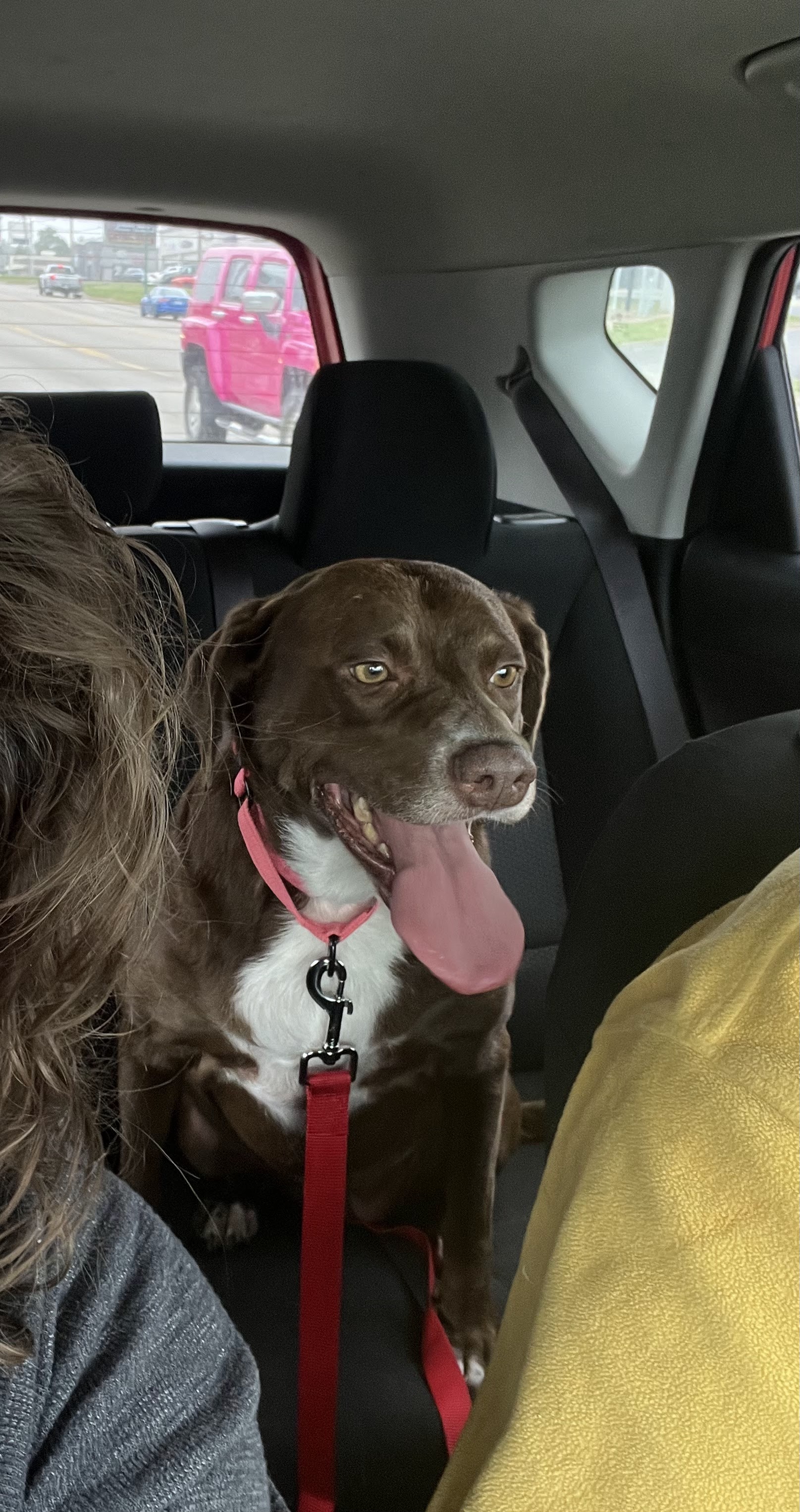
Photo of the week: Brownie! This photo was taken when we were bringing her home just after we adopted her. You can’t see it, but she was shaking. She had no idea where she was going or what was happening. Being nervous made sense.
Sometimes, I get nervous, seemingly about nothing. Sometimes a day is going along nicely, and then that familiar feeling of tension in my stomach comes along. Or sometimes, I do have something to do that is innocent, like cleaning my bedroom, and that feeling comes up again.
Our bodies have nerves and brains that are always scanning for danger. That is good! Sometimes they pick up on something that the logic part of our brains doesn’t even recognize as a danger. That feeling of anxiety is trying to protect us from something that may be familiar to our nervous system.
For example, today I have to run an errand and I feel anxious. My logical brain says it is not a big deal. And likely, once I start out the door, the nervousness will ease up. But all day, I have been thinking of this thing.
This is what I do with this feeling: First, I notice where it is in my body. For me, it is in my stomach. It feels like I have adrenaline rushing through me. Then, I sit with the feeling and get curious about it. What about this errand is getting to me? I realize it is that a part of me has been running thoughts about what could go wrong. They are vague ideas, not fully formed. So, I try to shine a light on them. Be specific, what is the fear? It has something to do with an expectation coming from somewhere. Honestly, I think what it is is that I am shy. I feel much more comfortable running errands with someone else. When it is only me, I sometimes feel like I appear awkward.
The next thing I do, once I have some specific fears in mind, I think about times I have done these things before and it works out fine. I remember details about doing this before and how I felt better once I started. I have noticed that when I am anxious, I get very still. So, for me, once I move in the direction of the errand, get dressed, go to the car, etc., I feel better.
This all happens fairly quickly, and I feel more calm. The anxiety is not completely gone. But I have changed my relationship to it. It is no longer ruling my emotions. It is more of an annoyance now.
What helps you when you feel nervous about something small or about nothing at all? Please share your ideas!
Photo of the Week: Brownie. We recently adopted a dog. She is 55 pounds of calm, not-jumping-up-on-you, 6-year-old, sweetness. We love her. It was my 14-year-old son’s idea. This is a big deal because he has been extremely afraid of dogs his whole life. This fear interferes with his life. So many people have dogs, dogs get loose and roam neighborhoods, people bring them into public areas. It is really difficult to avoid them. He thought maybe having one, becoming familiar with the ways of a dog, might help him overcome his fear. It is a slow process, but he loves Brownie and is now comfortable with her. He hasn’t yet been around other dogs to see if the Brownie-effect transfers.
I am proud of my son for finding a way to face his fear.
Fear is an emotion that can come from unknown origins or from some type of trauma. It is an emotion that can feel overwhelming. VERY simply put, our old part of our brain can pick up on triggers. It sends a message to our bodies to be on guard. We may go into fight mode, flight mode, freeze mode, or fawn mode.
We have a “window of tolerance.” This is when we feel emotionally comfortable. When we go above the window, we feel like fighting or fleeing. We are agitated. When we go below the window, we freeze or fawn.
It is important to understand that fight, flight, freeze, fawn are all coping strategies. They are your body’s way of protecting you. They are not weaknesses.
At some point, with some fears, many of us reach a point where we want to change our relationship to those fears. In my son’s case, the disruption the fear is causing in his life has caused him to search for a solution. This “exposure therapy” seems to be working for him.
Many of us experience anxiety, which is a form of fear. It may be situational; it may be chronic. There are different ideas of how to move past, or function with, this feeling. It is hard work. If you have been living with anxiety, you are already working hard! It takes a lot of energy to function with anxiety. There is help, though. Speak with a therapist (that idea may provoke anxiety!). Ask them their outlook on anxiety. They may believe it is trauma-based, or that exposure therapy can be a tool, or that mindfulness may work, or other ideas. Find someone who you are comfortable with and be ready to work hard. You don’t have to suffer alone. If you have been living with anxiety, know that you are already strong. And you can learn to use that strength in a new way.
I’d love to hear your thoughts on what has helped you with fear. Please share!
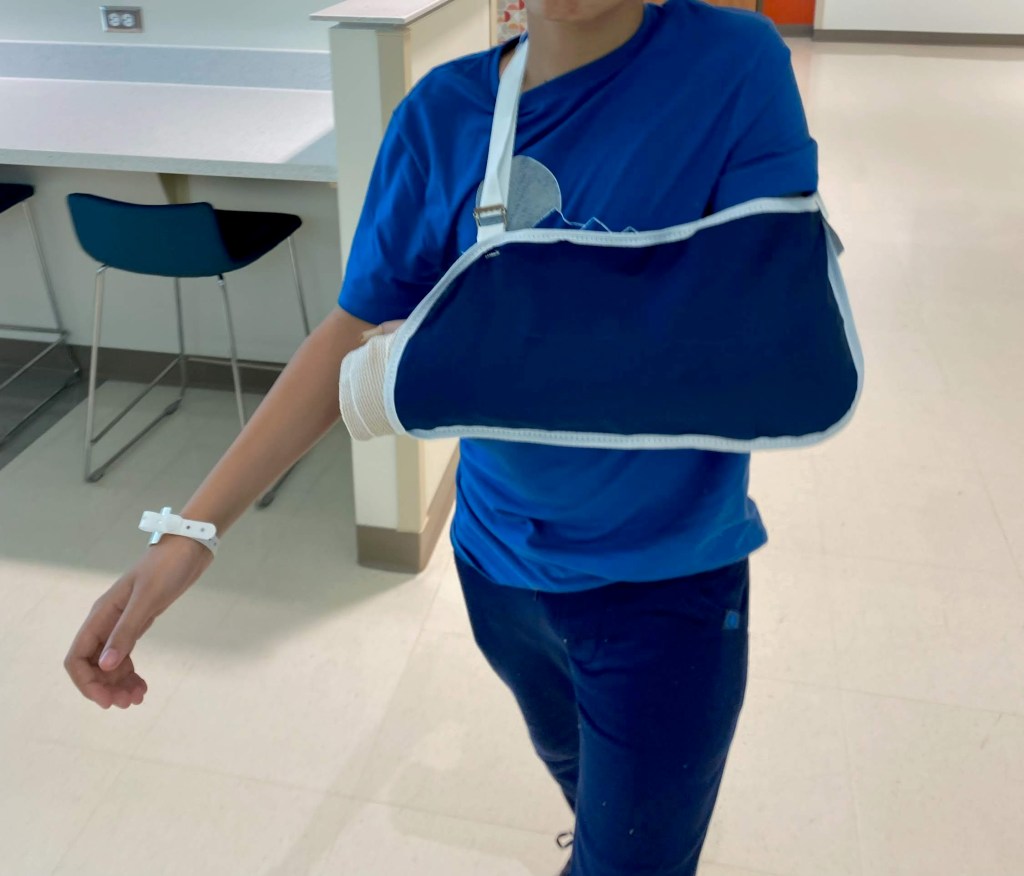
Photo of the week: my teen son with a broken arm. At times, we may wish the most difficult problem was a broken arm.
A few years ago, when I worked with several teens and young adults, I noticed that every single parent of people in that age group felt as though they were in a crisis. The issues included mood disorders, drugs, sex, impulsivity. The kids often felt that they, too, were in crisis, though not always.
When a person has a new baby, they often have access to community support. There are new parent groups. There are parenting classes. Activities for children provide an opportunity for the parents to feel connected.
Not so when you are the parent of a teen or young adult. I found that the parents had feelings of shame and isolation. The problems seemed so big and they felt that if they had been “better” parents, the problems would not be so overwhelming, or even there at all.
I think the shame parents feel is a major obstacle to healing. When something is hidden, it festers. Community is important, for the support and for the insight others may have.
In October, I am starting a six week group for parents of teens and young adults. While there will be an educational component, the main benefit is the opportunity to form connections and to feel less alone. It is hard to navigate these waters–how to let go, how to foster their responsibility, how to handle fear. All the while, parents struggle to maintain their own lives and self-care.
You are not alone in this.
What strengths have you found in parenting teens and young adults? What challenges?
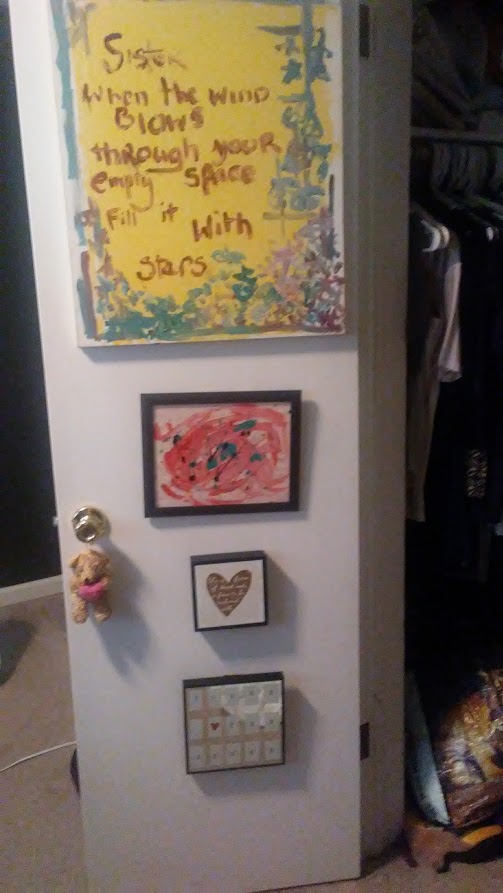
Photo of the Week: closet door. A few years ago, I lived in a house that I considered to be too small. For most of the time I lived there, I pushed against that reality. I was always slightly annoyed with it. Four of us were living in this place and I wanted more. I wanted to have parties. I wanted my sons to be able to have more than one friend over at a time. I was grateful to have a home…but my gratitude came with a “but.”
Eventually, I decided to create appreciation. We bought paint, and started with our bedroom. We got lovely curtains at a flea market. I decorated my closet door with things that were inspiring to me–gifts and words of encouragement. When I would open that small closet in the morning, I would see things from people I loved–a great way to start the day.
What I had done was change my relationship with my space. I actually came to really love the space.
My husband has had ankle/foot pain for several years. He has seen doctors and tried different ways of helping the pain. Recently, he has changed his relationship with his feet and ankles. He started with paying more attention when washing his feet in the shower, using lotion, appreciating the feel of the grass when walking through the yard without shoes, finding stretching exercises that felt good. He began honoring and cherishing his feet and ankles. He said, “I connected my brain to my body.” There is still some pain, but he feels more connected, more integrated.
I am not advocating giving up doctors and medical help. I am advocating for changing relationship.
I have decided that I am going to change the relationship I have with my stomach. This is the part of my body I dislike the most. I spend more time than I would like thinking of what I don’t like–its size, when it feels sick, when I feel nervous and tense in my stomach. Instead, I am deciding to appreciate that I have a stomach. I appreciate that it is the giver of so much emotional insight. It can be difficult to change a relationship. I think it will be worth it, though, to learn to appreciate this part that I give so much energy to disliking.
Recently, I was speaking with someone who said they did not like when they felt anger. We talked about changing the relationship with anger. We got curious and wondered what it would be like to take the information anger could give–am I being mistreated? is something hurting a childhood wound?–and making a decision on how to act, rather than reacting and thinking there was no choice or power to be had.
I think there is power in changing the relationship with something you dislike but must deal with anyway. It is different from only gratitude. It is creating an honor for the thing’s function. Sometimes, it is important to end relationships with things you dislike. Sometimes there is value in changing the relationship, though.
What are relationships you could change? How would you go about it?
Photo of the Week: Rosebud. The house I live in now was previously owned by a Master Gardener. I am not a Master Gardner. In fact, I am not really an amateur gardener either. The yard is big and planted with beautiful flowers and shrubs. I was excited to move in and get to see the blooms throughout the year.
At this point, four years later, the garden is a kind of “experiment.” Early on, feeling overwhelmed and a little embarrassed while giving a tour of the garden, I saw one plant I could actually identify as a weed. I made a statement about needing to pull it out. My brother, a scientist, said “No! That plant is great for birds!” I thought this was wonderful! Less weeding!
As the garden becomes more and more overgrown through the years, I find I enjoy it more. There are a lot of weeds. And there are still the ornamental plants. Also, we are adding native plants that require very little maintenance and benefit the birds and bugs in the area.
I understand weeds can choke out other plants. My husband has grown more interested in tending to the garden and he sometimes removes weeds. But what I have found is that the weeds add dimension to the garden–height and texture. Ours is not a silent, manicured space. It is alive with birds and the sounds of bugs. We keep trimmed pathways and every time I walk them, I see new things–it is an adventure!
I think there are obvious metaphors regarding gardening, gardeners, and weeds. This is what strikes me today, though: so much is in the eye of the beholder. What we, as a society, consider a “healthy yard” has changed as we learn more. Dandelions were once considered harmful. Bradford pears were once considered beautiful additions. Now, many allow dandelions, and naturalists want people to rid their yards of Bradford pears. What is a timeless fact is that plants affect each other, and therefore, the larger environment. We humans continue to learn. As we learn, we can be open to changing our view of what is helpful or harmful. This applies to physical and mental health. Continual learning is so important.
What have you learned that has changed your view over time? How do you tend your mental health garden?
Jon Herbert–writer, director, actor, and theatre instructor–and I have started a new podcast called “The Playful Healing Podcast”! In our podcast, we will interview people who engage in creative play and people who are on a healing path and/or who help others heal. We will talk about the intersection of creative play and mental health. This first episode is about how art can be healing, what therapy is and is not, and our upcoming therapeutic drama workshops, which will begin in August. Listen and let me know what you think!