Are you a couple, adult or teen who is feeling overwhelmed and searching for healing? Therapy can help. I practice Emotionally Focused Therapy and EMDR. Therapy here is secular, but affirming of faith/spiritual practices. All are welcome. Your identity is important.
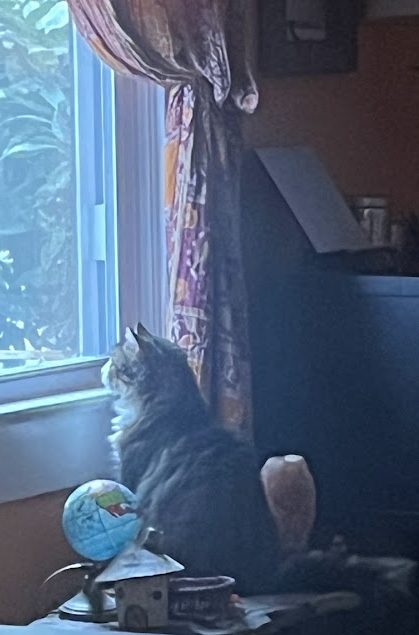
Photo: A lone kitty, sitting beside a globe, gazes out the window. Is he waiting for someone, or something, to return?
I haven’t written here in over one year. I wasn’t away for any particular reason. But now it feels like time to return. I have changed in this time since moving to North Carolina. I think I would like to explore that in some upcoming posts. I am relearning who I am in this new part of my life. In the past two years, just after moving here, I found out I had cancer. The surgery and radiation are over and I am doing well. Another new thing is menopause. Wow–that is a powerful force! Family relationships have shifted and grown. My career has changed, as I am now at an agency in NC as well as maintaining Growing Connections Counseling on a smaller scale. Lots of changes.
I am happy to be here again and would like to share with you. Maybe something will resonate with you. Maybe you will reach out to me, too.
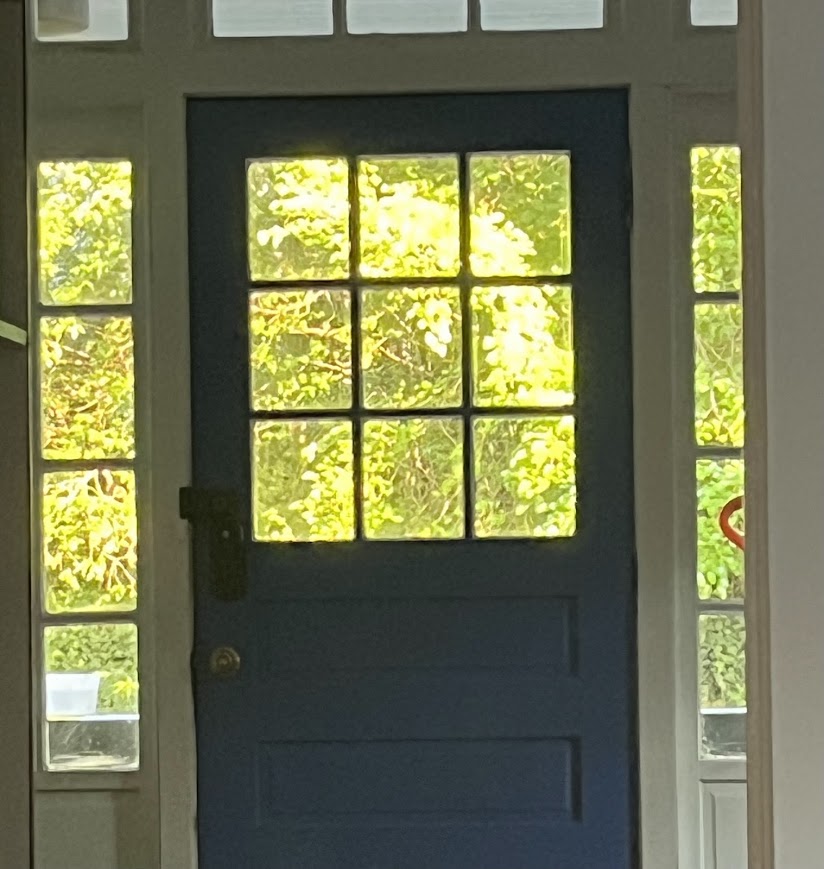
This is the interior view of my front door. I took this photo because all I could see from where I was sitting, was trees. I love that. However, it is not an accurate representation of what is actually outside my front door. It is an illusion. Rather, outside is a concrete retaining wall that has trees and bushes and vines growing all over it. I think it is lovely. But it is not as it appears from my position inside the house.
Much can be said about doorways and perspective. Doors as portals. Closed doors and safety or inhibition. Open doors as opportunity or vulnerability.
Today, though, this photo has me thinking about one’s surety of one’s own perspective as truth. If I were to remain sitting on the couch where I took the photo, I would be sure that I lived in a forest. If I went to the window, I might believe that while I am on a street with other homes, surely I am across from a forest, or at least a woodsy yard.
But if I open the door, if I cross the threshold, I could open my perspective. I could hear traffic–surely this is not a forest! But what? If I go through the door, cross the street, touch the wall, I would learn where I am. I would have entered an adventurous world and be ready for growth and learning!
But if I stay on the couch, resting in my singular untested perspective, it will be harder to learn. I may feel betrayed when the leaves fall and I find that I live near a wall and not a forest. Or, someone may tell me of the wall and I would not believe them.
There is so much to learn! So much adventurous growth that is possible! It requires movement. Move toward the door–one step at a time. Cross the threshold! The world awaits!
What threshold is waiting for you to approach and cross?
Photo of the week: Brownie! This photo was taken when we were bringing her home just after we adopted her. You can’t see it, but she was shaking. She had no idea where she was going or what was happening. Being nervous made sense.
Sometimes, I get nervous, seemingly about nothing. Sometimes a day is going along nicely, and then that familiar feeling of tension in my stomach comes along. Or sometimes, I do have something to do that is innocent, like cleaning my bedroom, and that feeling comes up again.
Our bodies have nerves and brains that are always scanning for danger. That is good! Sometimes they pick up on something that the logic part of our brains doesn’t even recognize as a danger. That feeling of anxiety is trying to protect us from something that may be familiar to our nervous system.
For example, today I have to run an errand and I feel anxious. My logical brain says it is not a big deal. And likely, once I start out the door, the nervousness will ease up. But all day, I have been thinking of this thing.
This is what I do with this feeling: First, I notice where it is in my body. For me, it is in my stomach. It feels like I have adrenaline rushing through me. Then, I sit with the feeling and get curious about it. What about this errand is getting to me? I realize it is that a part of me has been running thoughts about what could go wrong. They are vague ideas, not fully formed. So, I try to shine a light on them. Be specific, what is the fear? It has something to do with an expectation coming from somewhere. Honestly, I think what it is is that I am shy. I feel much more comfortable running errands with someone else. When it is only me, I sometimes feel like I appear awkward.
The next thing I do, once I have some specific fears in mind, I think about times I have done these things before and it works out fine. I remember details about doing this before and how I felt better once I started. I have noticed that when I am anxious, I get very still. So, for me, once I move in the direction of the errand, get dressed, go to the car, etc., I feel better.
This all happens fairly quickly, and I feel more calm. The anxiety is not completely gone. But I have changed my relationship to it. It is no longer ruling my emotions. It is more of an annoyance now.
What helps you when you feel nervous about something small or about nothing at all? Please share your ideas!
Photo of the week: my teen son with a broken arm. At times, we may wish the most difficult problem was a broken arm.
A few years ago, when I worked with several teens and young adults, I noticed that every single parent of people in that age group felt as though they were in a crisis. The issues included mood disorders, drugs, sex, impulsivity. The kids often felt that they, too, were in crisis, though not always.
When a person has a new baby, they often have access to community support. There are new parent groups. There are parenting classes. Activities for children provide an opportunity for the parents to feel connected.
Not so when you are the parent of a teen or young adult. I found that the parents had feelings of shame and isolation. The problems seemed so big and they felt that if they had been “better” parents, the problems would not be so overwhelming, or even there at all.
I think the shame parents feel is a major obstacle to healing. When something is hidden, it festers. Community is important, for the support and for the insight others may have.
In October, I am starting a six week group for parents of teens and young adults. While there will be an educational component, the main benefit is the opportunity to form connections and to feel less alone. It is hard to navigate these waters–how to let go, how to foster their responsibility, how to handle fear. All the while, parents struggle to maintain their own lives and self-care.
You are not alone in this.
What strengths have you found in parenting teens and young adults? What challenges?
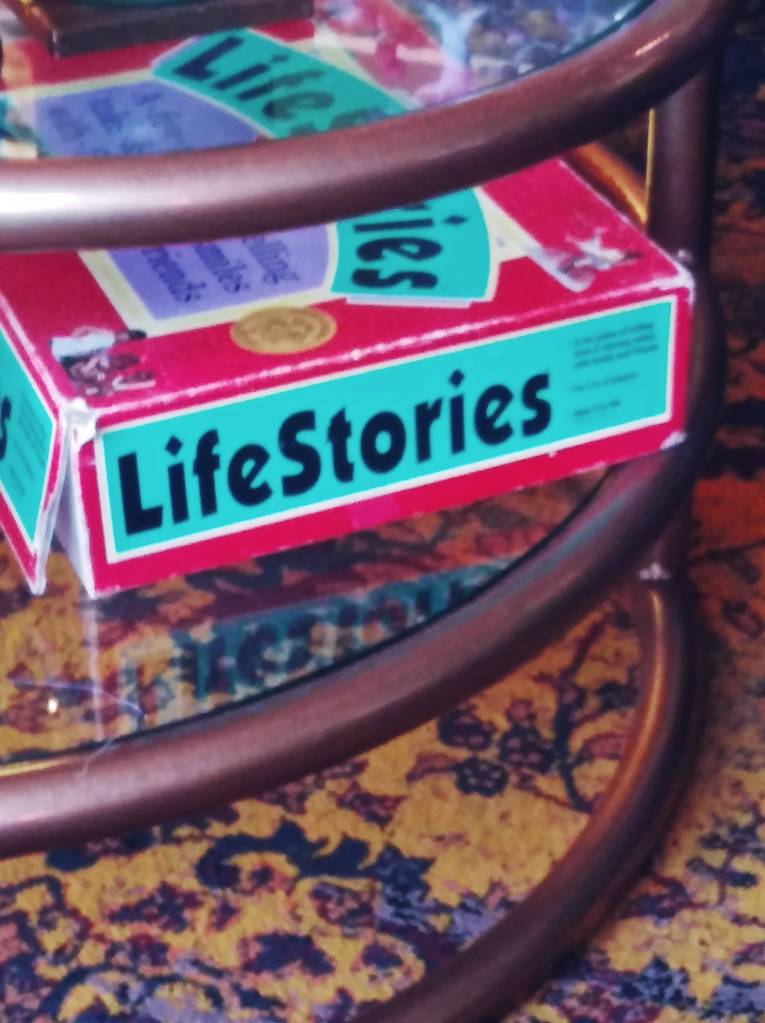
Photo of the Week: Tattered game of Life Stories. Life Stories is “a fun game of telling stories with family and friends.” It has four types of questions: Etchings (questions about interests), Valuables (questions about things you value), Memories, and Alternatives. No one wins or loses–you just go around the board asking and answering questions about each other. I have found that some love this game; others hate it.
Recently, I finished reading the book “Man’s Search for Meaning” by Viktor Frankl. He was a therapist who survived the Holocaust. The book tells his story through the therapist’s lens. One idea I took away from the book was that the goal of life is not simply to be happy, but to have meaning. It seems that a sense of meaning is what helped him survive the concentration camps.
Lately, I have encountered several people who have gone through painful, major life changes. They are in a transitional space where they have lost what they once thought was their meaning, and have not yet found a new meaning. This can be a devastating space to be in.
How does a person begin to find meaning? I think there are many, many ways to do this. However, I think of Life Stories. Those four types of questions can be a guide–what are your interests (hobbies, inclinations); what do you value (what draws your concern when you listen to the news, what makes you brighten up); what are your memories (what do you remember caring about when you were younger, what injustices do you remember experiencing); alternatives (how do others see these things in you if you cannot get in touch with these things yourself). When we look at these questions, we can discover meaning. For example, what is the underlying reason you used to enjoy serving meals at the soup kitchen? Was it a love of serving? Was it a love of being around food and gatherings? Be curious about your life.
In my own life, my meaning has changed over the years. Sometimes meaning can be swept away abruptly. At those times, hold on. Breathe. Meaning can come back. I think that sometimes, our meaning is like winter. It appears that things are dead, but it is an important stage that generates new life. We see this happen in nature. We are part of nature. Happiness isn’t enough, but it can be an indicator of your deeper meaning.
What is meaning for your life? How have you found it?
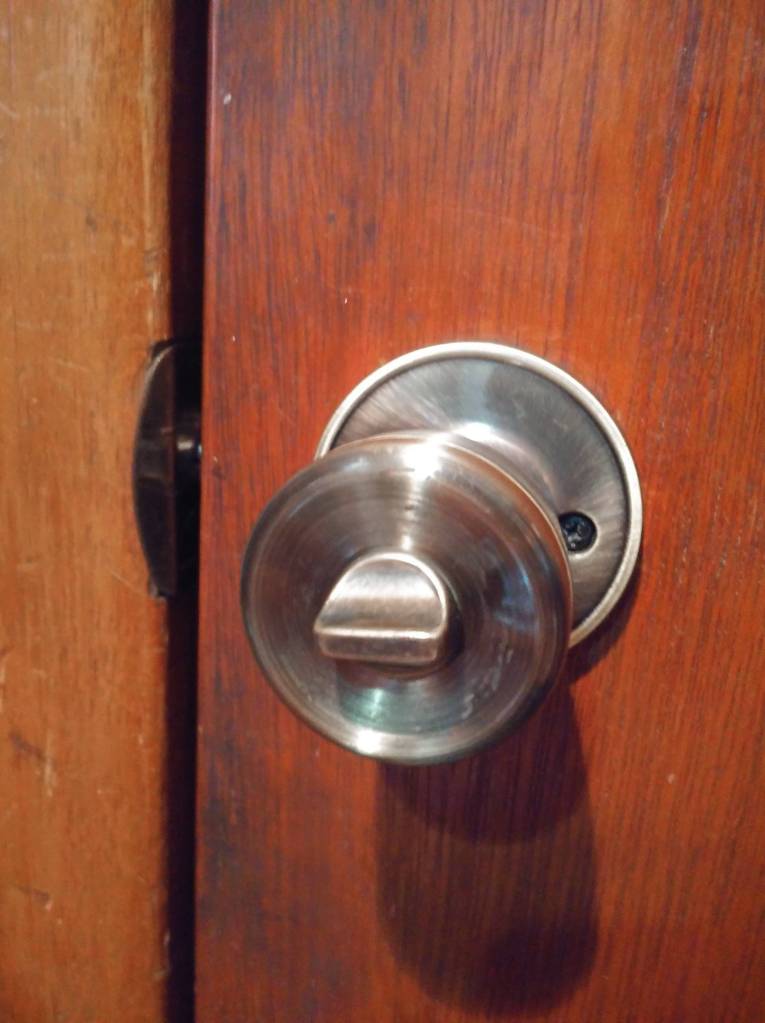
Photo of the Week: Doorknob. Doors. Portals. “When one door closes, another opens.” “Opportunity only knocks (on the door) once.” “Leave your problems at the door.” “Don’t let the door hit you on your way out.”
Doors represent opportunities for change. When you go through a door, you enter a new world–whether your front door, or even a closet door. We close doors–shutting out possibility, for better or worse. We open doors–inviting possibility, for better or worse.
The doorknob in the photo is tempermental. To close it well, the doorknob must be turned and closed gently, then a gentle push on the door will make it latch. One would think that closing the door by pushing or pulling hard on it would make it latch. But, inevitably, the house shifts, and it opens. Being that this is the door to the garage, it opens to an unwanted opportunity at inconvenient times.
Opportunity in life can be like that. It can show up at inconvenient times, when you aren’t ready. And it may be time to gently, yet firmly and assertively, close the door so that YOU decide when to open to the opportunity. Slamming the door will only make it pop open again when you don’t want it to. It is counterintuitive. Aggression tends to have unwanted outcomes. Assertiveness, decisions made with control, tends to make things go better.
What are the doors of your life? Do we recognize that every time we open or close a door we are working with possibility? Closing a closet door after I have chosen a shirt to wear is a decision that I have committed to. Opening the front door to go to work is stepping into the world with all of the unknowns–for better or worse. It is a commitment to facing adventure. Opening a door to allow a visit from a friend is inviting opportunity for growth. Locking the door before going to sleep is to prevent unwanted opportunity.
When I was little, if I was upset, I would run to my bedroom and slam my door. My father would sometimes come and I would be in trouble. Slamming that particular door caused the trim to separate a bit from the wall. Slamming that door, aggressively shutting out my family, damaged the house, my home, my place of belonging. It was too much. However, firmly and assertively closing the door led to privacy and left my home intact. It gave a space for healing from the frustration rather than heaping problems–not only did I have the frustration that led to the slamming, but then I was also in trouble and had to deal with that.
What doors are in your life? How do you handle the opening, closing, locking? What insights can you share?
Photo of the Week: Green leaves. I took this photo on a frozen December morning. It had been below freezing for several days and I was fascinated by the fact that this plant still had green leaves. Someone told me that it may be because the leaves on the ground kept the roots warm.
Whether that is true or not, it made me think. It is a wonderful metaphor! The dry, dead leaves that have fallen to the ground, protect the roots from freezing and damaging the above-ground leaves of a plant so it can continue to produce and clean the air. Often, “roots” metaphorically means the foundations of our lives–the core of who we are. Dry, dead leaves are often considered to be waste.
Ralph Waldo Emerson said, “…the whole of nature is a metaphor of the human mind.” So, I would say that a lesson of the green leaves is that, if we value the “waste” experiences–the mistakes, the failures of our lives–as learning experiences, these experiences can be used to protect and nourish the core of who we are. Then, we can continue to function and contribute even in the harsh climates of life.
I think part of the lesson lies in the way a person uses the dead leaves of life. Sometimes, the dead leaves smother plants when the weight of the leaves snuffs out the oxygen the plant needs. What can a person do when the weight is too much? Some people rake leaves to protect grass. To me, this means allowing others to help when you are feeling crushed by life. Other times, plants will, in a way, “hibernate” until the crushing leaves dry up and blow away. This shows that there are times to wait, to care for the self quietly until the circumstances shift.
Maybe, when feeling stuck, maybe a good thing to do is to look to nature. How does nature heal itself? After all, we are nature, too. What do you think? What truth have you found in nature?
Photo of the Week: Afternoon coffee. I am generally a morning person (after much training). I used to be a night person. I have never liked afternoons, when I feel a little tired or drained. My energy level is high in the morning, low in the afternoon, and comes up a bit in the evening until time for sleeping.
Today started out good, but I gradually became more anxious and felt kind of down. I felt like my energy level was spiraling. I could not think of a way to salvage the day.
Until I remembered afternoon coffee.
This is not a push for caffeine. Rather, it is a push for re-calibration. To adjust; to start over. I took a nap and drank an afternoon coffee. I created a new morning. My energy level came back up and my anxiety faded. When I cannot take a nap (which is, admittedly, luxurious), I have still had an afternoon coffee or tea and created some type of break. Maybe just leaving my desk and gazing out a window. This has been enough to simulate a second morning.
How did this work?
I think the reason this can be effective is more mental than physical. I interrupted the path of the day. I had been feeling stuck in the “I shoulds.” So, I created a break which caused a perspective shift.
If you are an evening person, maybe you like the coziness of low lights, for example, you could create a break and simulate a new evening. You could do something that you normally do in the evening, or you could do something to create the evening atmosphere.
Today, I am having two mornings and an evening. I am mentally skipping afternoon. How have you re-calibrated when you have had a day that was not going well?
Yesterday was the seventh anniversary of my mother’s death. Grieving is a complicated thing. It follows no smooth path. It does not expire.
How does a person grieve? I felt somewhat numb for a long time. I still do some. For me, grieving my mother has been a little at a time.
What does it mean to move through grief? How does good mourning happen? What do you do? These are the questions I have wrestled with. Maybe you have, too. Maybe you have grieved for a loved one, an opportunity, a life that never came to be.
I think there are many ways. Here are some.
Write. Write a list of ways the loss has impacted you. Write the same thing over and over if you need to. Be poetic if you want, use symbolic language.
Move. Finish the actions your body wants to make. Kick or punch something soft, push against a wall (push hard), squeeze or hug a pillow or item of their clothing, stomp on the ground or jump. Let tears flow if they come. Let a scream out if it comes. Or move gently, like a dancer, touch soft things and be aware of your aliveness.
Meditate. Set a timer and let yourself feel the emotions. When the timer ends, come out of your meditation gently. Hug yourself or take a warm shower. Be gentle.
Talk. Find a friend or therapist who will listen. Speak the good and painful things. Let a friend or therapist be there.
Music. Listen to music that reminds you or make new music. Sing or dance or simply sit.
Create. Use clay, paint, crayons, fabric to create from your feelings. Create love or loss, pain or joy.
Nature. Find something natural and contemplate the wonder of existence and cycles.
I think it is important when you have these times to have a beginning and end to the moments. It is kind of like keeping your grief in a box. It is always with you, but only sometimes visit it. Find grounding methods to help you come out of the moments (like paying attention to your breath and body).
It may feel as though the feelings will swallow you and you will never get out. That can be scary. Feelings move on when you allow moments of feeling. Let them in. Denying them makes them overtake you when you may not want them.
You can move through grief. A loss changes you. That is true. Pain has its impact. Move with the seasons of grief.
How have you handled loss in your life? Share your thoughts.
Today, where I am in Missouri, is a rainy day. It is really the first day that feels autumnish to me. I noticed in September, though, that the sunlight had shifted and brought on a different feeling.
Some people feel depressed in fall and winter, when the days are shorter and the darkness is longer. I encourage anyone who is feeling depressed to please seek out therapy, especially if your depression tends toward feeling like hurting yourself. The following ideas are activities that can help boost a mildly low feeling.
–Learn about what is happening in the natural world in your area at this time. What are animals and plants doing? Learning about nature can lift the feeling of “everything is dying.” What is actually happening can shift your perspective.
–Take walks and take photos! Go outside and find small details to photograph. Look at the tops of trees, which you may not normally do. Find natural patterns in your surroundings.
–Pay attention to what your body feels like. Feed yourself nourishing foods before you are hungry. Get more rest. When you are exercising or moving, be mindful of what feels good and practice gratitude for your senses.
–Close your eyes and listen to the natural sounds in a park, forest, or yard. What birds are in your area? Geese? Loons? Do you hear ice cracking? Do you hear crunching leaves or squirrels digging for nuts?
–Decorate your home in fall colors. If you don’t like fall colors, bring in spring colors! You can make art or bring in silk flowers. Whatever you want! Also, pay attention to your indoor lighting. For some, turning down light and lighting candles makes it cozy. For others, brighter feels better.
–Just as nature turns inward, so can you. Maybe now is the time to begin journaling or writing stories. A gratitude journal, a nature journal, a photo of one particular tree each week from now until spring. Track your feelings, create a cookbook, feed what feels good to you.
–Turn to others. Sometimes when feeling down we only want to be alone. Honor that. Other times, we are aware that we are avoiding in a way that is not good for us. Make a standing date with someone you are comfortable with. Aim for weekly dates. Or attend some event weekly. Libraries and universities often have free and frequent events. This is the schedule for the library where I am: https://thelibrary.org/programs/other/adults.cfm
What gets you through autumn and winter? I would love to hear your ideas!