Are you a couple, adult or teen who is feeling overwhelmed and searching for healing? Therapy can help. I practice Emotionally Focused Therapy and EMDR. Therapy here is secular, but affirming of faith/spiritual practices. All are welcome. Your identity is important.
Graphic of the day: Growing Connections Counseling!
Have you ever made a mission statement, vision statement, philosophy statement, or “Who Am I?” statement, for yourself? It can help you hone in on what you want in your life, both personally and professionally. This is mine for Growing Connections Counseling:
Mission Statement: I provide a safe space, support, and guidance for people to explore their emotions with curiosity in order to increase their flexibility, adaptability, coherence, energy, and stability (FACES–Dr. Dan Siegel). I help clients, who are struggling with recurring issues, to enter their emotional world, step by step, to gain greater understanding of self and to integrate emotions into their lives. Clients are empowered to deeply heal and become who they want to be.
Vision Statement Finding deep healing through emotional exploration and integration.
Philosophy Empowering–client to become who they want to be.
Supporting–healing through guided encounters and connection.
Integrating–emotions into everyday experience.
Exploring–with curiosity and wonder.
Who Am I? I am a mental health therapist and I work with individuals and couples who have trauma or feel overwhelmed. I help clients work on an emotional level instead of only the cognitive level so they can move toward deep healing and who they want to be.
So, who are you? What are you about? What do you want in your life? Please share!
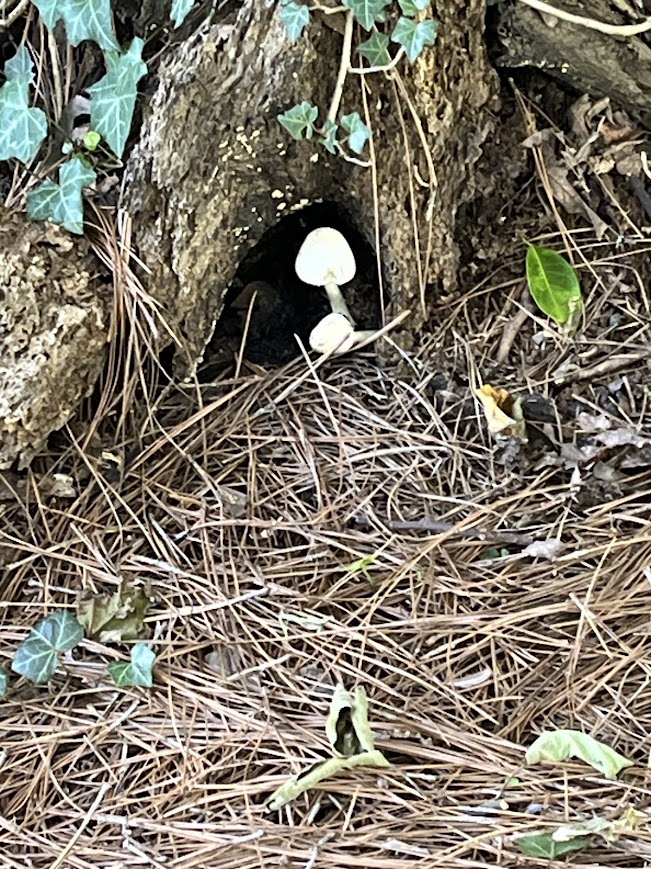
Recently, I moved to North Carolina and found that there is a fig tree growing in the front yard! One day, I walked past, and was excited to see these mushrooms growing beside the “fairy door” at the base of the tree.
Fig trees, mushrooms, fairies–all have lore. I am often a “logical” minded person, but I felt a surge of Magic when I saw this!
That is important.
Einstein said “Logic will get you from A to B. Imagination will take you everywhere.” Allowing emotion and imagination deepens life and provides important information that logic alone cannot give.
Imagination and emotion create connections to a person’s inner self. Logic alone stays on the surface. To make decisions that are truly good for us, we need to reflect on emotional aspects and connect them to logic. We can pay attention to our deepest longings and connect that information with the logical part of ourselves. When we use our creative imaginations to aid that connection, we can make better-informed decisions.
That “fairy door day” was a reminder to me to be present and creative, to allow hopefulness while in the midst of a stressful move to a new place. What imaginative reminders have you noticed lately?
Photo of the week: Red leaf in my backyard. I chose this photo today mainly because it was in my own yard.
For many of us, it is easy to feel overwhelmed by bad news–personal, as well as global. It can leave us feeling powerless, hopeless, sad, angry. When we are in that headspace, it can be difficult to function in our everyday lives.
One thing that helps me is to find a space where I can make an impact. There are so many important issues that I care about. At the same time, there are only a few that I feel adequately prepared to do something about. These are spaces where I feel knowledgeable and motivated. For me, one of those spaces is the topic of mental health. Another issue is access to mental health resources. So, I offer sliding scale mental health services and free presentations to organizations.
The first step is identifying what issues move you, then finding what you are skilled at. The third step, though, is noticing that you are having an effect. Some of us discount the impact we make in the lives of others. It is important to be aware that, even if we were the most powerful person in the world, our impact on individuals and issues would still be limited. The impact you make may seem small, but it is important. We must not discount that.
The photo of the week is from my yard. I chose this photo because it is a representation of the idea that I may only have impact in my small circle–my “yard”–but it is still an impact. Being intentional with my actions, noticing there is impact on issues I care about, helps me ward off feeling overwhelmed.
What helps you when you feel overwhelmed by painful news? What do you do when you feel powerless?
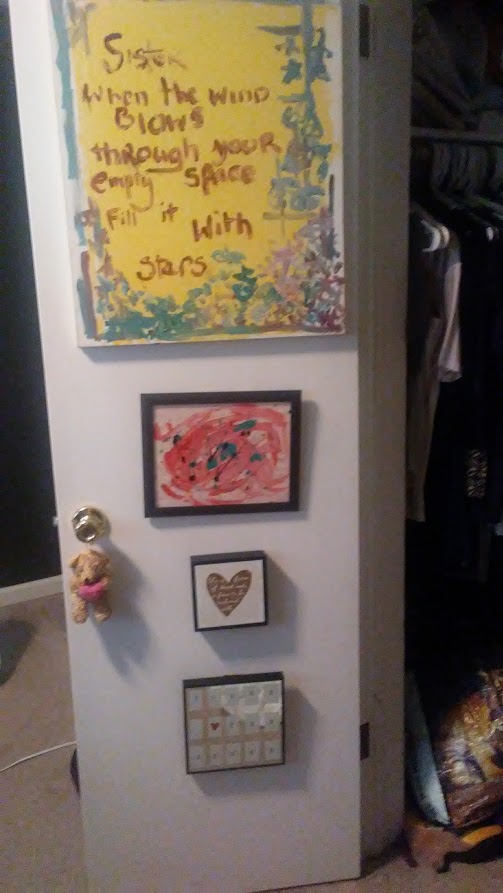
Photo of the Week: closet door. A few years ago, I lived in a house that I considered to be too small. For most of the time I lived there, I pushed against that reality. I was always slightly annoyed with it. Four of us were living in this place and I wanted more. I wanted to have parties. I wanted my sons to be able to have more than one friend over at a time. I was grateful to have a home…but my gratitude came with a “but.”
Eventually, I decided to create appreciation. We bought paint, and started with our bedroom. We got lovely curtains at a flea market. I decorated my closet door with things that were inspiring to me–gifts and words of encouragement. When I would open that small closet in the morning, I would see things from people I loved–a great way to start the day.
What I had done was change my relationship with my space. I actually came to really love the space.
My husband has had ankle/foot pain for several years. He has seen doctors and tried different ways of helping the pain. Recently, he has changed his relationship with his feet and ankles. He started with paying more attention when washing his feet in the shower, using lotion, appreciating the feel of the grass when walking through the yard without shoes, finding stretching exercises that felt good. He began honoring and cherishing his feet and ankles. He said, “I connected my brain to my body.” There is still some pain, but he feels more connected, more integrated.
I am not advocating giving up doctors and medical help. I am advocating for changing relationship.
I have decided that I am going to change the relationship I have with my stomach. This is the part of my body I dislike the most. I spend more time than I would like thinking of what I don’t like–its size, when it feels sick, when I feel nervous and tense in my stomach. Instead, I am deciding to appreciate that I have a stomach. I appreciate that it is the giver of so much emotional insight. It can be difficult to change a relationship. I think it will be worth it, though, to learn to appreciate this part that I give so much energy to disliking.
Recently, I was speaking with someone who said they did not like when they felt anger. We talked about changing the relationship with anger. We got curious and wondered what it would be like to take the information anger could give–am I being mistreated? is something hurting a childhood wound?–and making a decision on how to act, rather than reacting and thinking there was no choice or power to be had.
I think there is power in changing the relationship with something you dislike but must deal with anyway. It is different from only gratitude. It is creating an honor for the thing’s function. Sometimes, it is important to end relationships with things you dislike. Sometimes there is value in changing the relationship, though.
What are relationships you could change? How would you go about it?
Photo of the Week: Drama Masks. This month is Mental Health Awareness Month. One reason I chose drama masks as the photo of the week is that our mental and emotional health exists on a spectrum. At one end is delight, at the other end is despair. Our human experience includes those and everything in between.
I think it is important to have a mental health awareness month because caring for your mental health still carries a stigma. Needing support carries a stigma. Many of our institutions seem to uphold the rugged individual standard–need no one, be self-sufficient, be independent, you are on your own. The times in my life when I have felt most alone, though, were my worst times–depression and anxiety were the outcomes.
My mental health story included over 40 years of depression, including suicidal ideation and self-harm. Most of my life, I woke with a sense of dread, making it difficult to be productive in any way. I struggled to appear to “have it all together” so I would not make others uncomfortable, all the while feeling as though I wanted to have never existed at all.
These are feelings many, many people experience. For me, the turning point came with a combination of medication and therapy. This led to the ability to develop honest and supportive relationships. In these relationships, I could lean when I needed to. I learned that I could be seen for who I am and that I was lovable as I am. I think this is a lifelong journey. This is where I am right now.
Another reason I chose masks for this week is that I think it is a struggle to take off our masks to show our authentic selves. Sometimes we need those masks, but sometimes wearing a mask becomes a habit. It can become difficult to know who our true self is. It is exhausting to constantly wear a mask, to hide our true selves. For many of us, the fear of not being accepted for who we are leads to self-loathing and distrust of others.
Who are you? When you remove the mask, what do you believe? What do you feel? What do you value? Do you know? At the top of the main page of this website, I wrote, “Your identity is important and valued.” As a therapist, I am interested in supporting you as you learn who you are and remove the mask. Who do you want to be at this time? I believe that is for you to decide.
So, for this mental health awareness month, our assignment is to make moves to embrace our authentic identities. Let’s do creative things to learn more about ourselves–write, sing, make art. Your identity is important and valued. What is your mental health story? Please share.
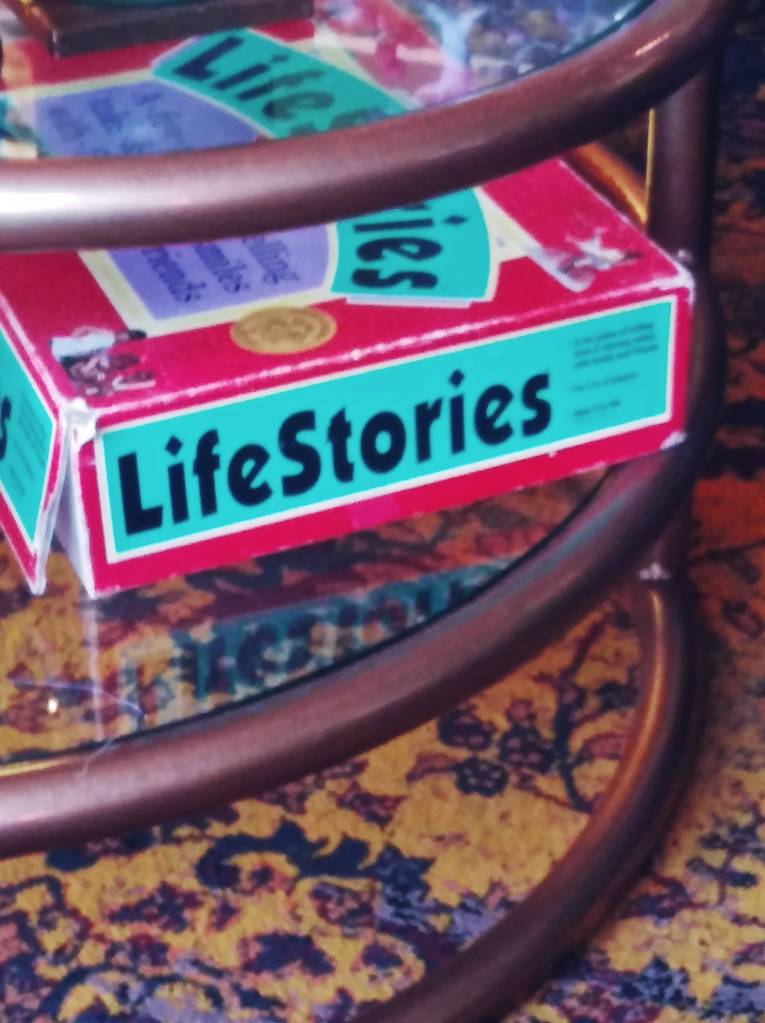
Photo of the Week: Tattered game of Life Stories. Life Stories is “a fun game of telling stories with family and friends.” It has four types of questions: Etchings (questions about interests), Valuables (questions about things you value), Memories, and Alternatives. No one wins or loses–you just go around the board asking and answering questions about each other. I have found that some love this game; others hate it.
Recently, I finished reading the book “Man’s Search for Meaning” by Viktor Frankl. He was a therapist who survived the Holocaust. The book tells his story through the therapist’s lens. One idea I took away from the book was that the goal of life is not simply to be happy, but to have meaning. It seems that a sense of meaning is what helped him survive the concentration camps.
Lately, I have encountered several people who have gone through painful, major life changes. They are in a transitional space where they have lost what they once thought was their meaning, and have not yet found a new meaning. This can be a devastating space to be in.
How does a person begin to find meaning? I think there are many, many ways to do this. However, I think of Life Stories. Those four types of questions can be a guide–what are your interests (hobbies, inclinations); what do you value (what draws your concern when you listen to the news, what makes you brighten up); what are your memories (what do you remember caring about when you were younger, what injustices do you remember experiencing); alternatives (how do others see these things in you if you cannot get in touch with these things yourself). When we look at these questions, we can discover meaning. For example, what is the underlying reason you used to enjoy serving meals at the soup kitchen? Was it a love of serving? Was it a love of being around food and gatherings? Be curious about your life.
In my own life, my meaning has changed over the years. Sometimes meaning can be swept away abruptly. At those times, hold on. Breathe. Meaning can come back. I think that sometimes, our meaning is like winter. It appears that things are dead, but it is an important stage that generates new life. We see this happen in nature. We are part of nature. Happiness isn’t enough, but it can be an indicator of your deeper meaning.
What is meaning for your life? How have you found it?
What are your favorite memories? The first that come to mind for me are of parties or camping or hiking. What first comes to mind for you? Moments with loved ones? Moments spent alone? How did you feel in those moments? Happy? Accomplished? Strong? Loved?
I have heard people say when they are stressed, they go to their “happy place.” This, honestly, always seemed ridiculous to me. How could a memory or imagination ease stress?
I discovered that, for me, there is a different type of memory that actually does help me relax. It is a kind of sensory memory. I have memories that I would never have considered to be “favorite memories” or even “favorite places.” But something about these memories relaxes my muscles, transports me in a way.
One example is from my childhood. I remember lying in my bed on summer evenings. It would be hot and the window would be open. I can remember the sound of bugs outside and the sound of the neighbor’s air conditioner running. I can recall those sounds so clearly and I can feel my muscles relax.
Another memory that relaxes me is from a hike years ago. I was walking in the mountains in southern California. I dropped my backpack and leaned against it on the ground under a tree. I can recall the feel of the warm sun, the smell of the sandy dirt and pines, and the sounds of the stillness in the air and occasional breeze. Again, I feel my muscles relax and a peacefulness settle in.
So, I think that if you have trouble going to your “happy place,” try thinking of an unexpected happy place. Try to remember a moment that was peaceful. One that brings to mind sensory memories.
Please share. Where have your happy places been? What are your peaceful moments?
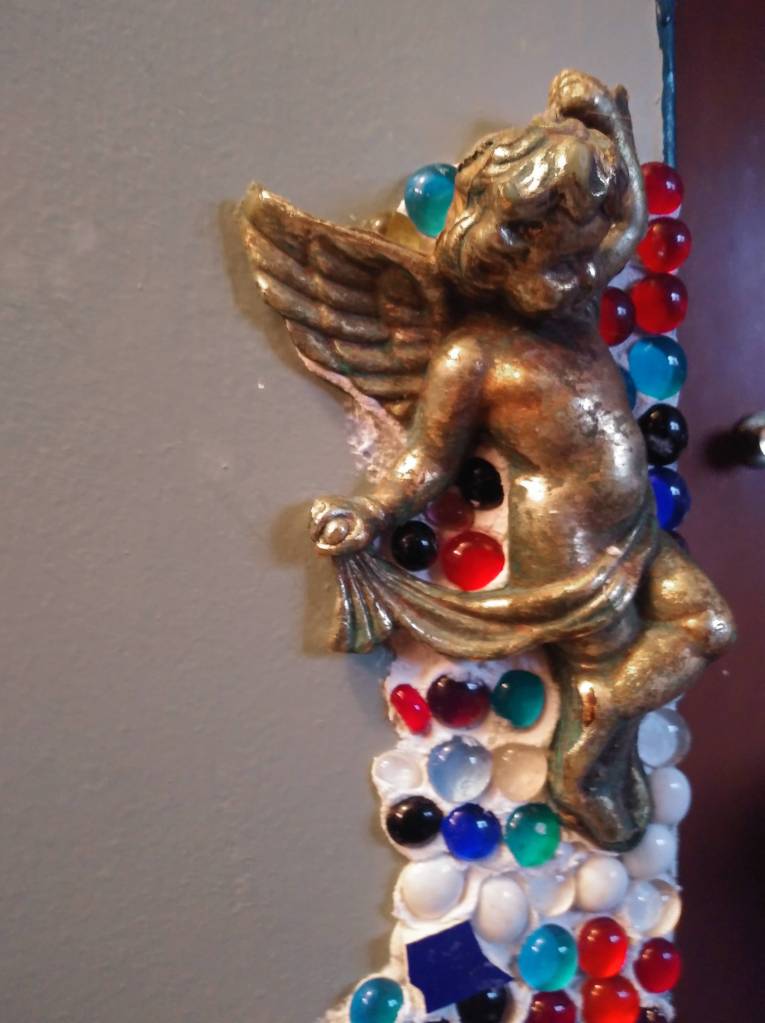
Photo of the Week: Angel. In some cultures and communities, angels are beings who are messengers or protectors. They provide guidance for the difficult journey that is life.
Whether we believe in angels or not, is kind of beside the point. We humans look for guidance, from angels, friends, teachers, signs, etc. We do not always accept the guidance. So, ultimately, it comes to a person’s own intuition and discernment.
How do we decide what to do in life situations? How do we know when to follow someone’s advice? Or forge our own path?
Generally, we have desires, hopes for particular plans to work out. Sometimes, those plans slam into dead ends. We have to decide whether to pursue the plan or go a different direction. The language we use in our minds matters. We may say “If I quit, I am giving up. And I’m not a quitter.” Or maybe, “This isn’t for me. Good things don’t last for me.” Both statements indicate a value judgement of ourselves. A statement of our worth is being made. So, sometimes our decisions are made based on what we believe about ourselves, a deep rooted, core belief, more than what may be best in the situation.
So, how to decide what to do? There are many factors to consider. One way of making a decision is to pay attention to what really energizes you. Use your imagination to see as many options as possible. For example, maybe you are trying to decide if you should take a particular job and are hesitating. It seems at first like either you take it or you don’t. But there may be additional options. Think creatively about whatever causes the hesitation. Maybe you could take the job, but start in a month rather than now. Maybe you could see if you could work from your home sometimes. Maybe you could not take the job, but could consult or volunteer. Whatever is causing the hesitation, use your imagination about it. What options energize you? Maybe it would be a pay cut, and you have bills to pay, but you could adjust your budget and make it work. Or take on a side hustle. If the idea of the job really energizes you, you may not need to spend so much on entertainment because you just feel better. Feeling energized, feeling good, in an important area of your life will affect other areas of your life.
I do not mean that a person should neglect responsibilities because something seems fun. I am suggesting that there may be more creative ways to meet responsibility. I also am not meaning “fun” when I speak of being energized. “Energized” here means an internal motivation that is peaceful and provides a sort of lift to your being. Not an adrenaline burst because you are doing something that will hurt others.
I have found in my own life, and through talking with others, there are times when we almost cannot not try for something. At those times, again, be creative. Open your options to possibility. But here, it is important to also see reality as it actually is. If a person, for example, tells you “no,” that is not an invitation to pressure them, whether an individual or an organization. Accept reality as it is and see what other possibilities open up. You may be blocking other opportunities by being too single-minded.
So, in making decisions, pay attention to what is energizing and accept what is reality. These are hard things sometimes. Be patient and compassionate with yourself. Personally, I don’t believe opportunity only knocks once. I believe it knocks in different forms many times.
What do you think? What contributes to your decision making?
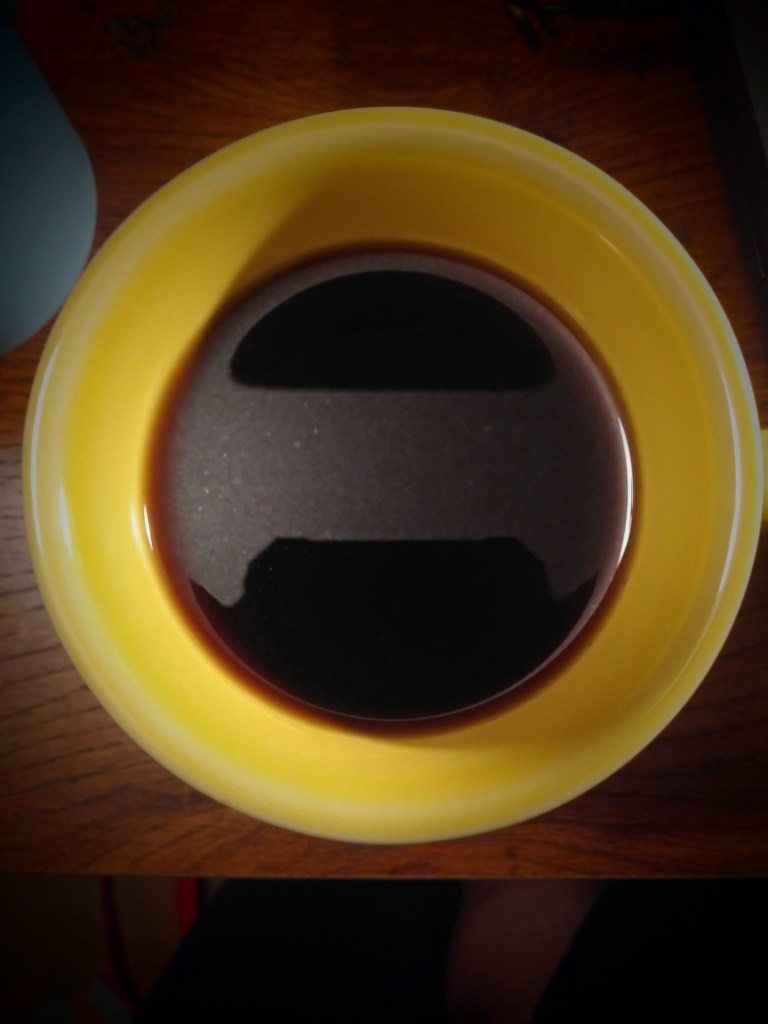
Photo of the Week: Afternoon coffee. I am generally a morning person (after much training). I used to be a night person. I have never liked afternoons, when I feel a little tired or drained. My energy level is high in the morning, low in the afternoon, and comes up a bit in the evening until time for sleeping.
Today started out good, but I gradually became more anxious and felt kind of down. I felt like my energy level was spiraling. I could not think of a way to salvage the day.
Until I remembered afternoon coffee.
This is not a push for caffeine. Rather, it is a push for re-calibration. To adjust; to start over. I took a nap and drank an afternoon coffee. I created a new morning. My energy level came back up and my anxiety faded. When I cannot take a nap (which is, admittedly, luxurious), I have still had an afternoon coffee or tea and created some type of break. Maybe just leaving my desk and gazing out a window. This has been enough to simulate a second morning.
How did this work?
I think the reason this can be effective is more mental than physical. I interrupted the path of the day. I had been feeling stuck in the “I shoulds.” So, I created a break which caused a perspective shift.
If you are an evening person, maybe you like the coziness of low lights, for example, you could create a break and simulate a new evening. You could do something that you normally do in the evening, or you could do something to create the evening atmosphere.
Today, I am having two mornings and an evening. I am mentally skipping afternoon. How have you re-calibrated when you have had a day that was not going well?
Today, where I am in Missouri, is a rainy day. It is really the first day that feels autumnish to me. I noticed in September, though, that the sunlight had shifted and brought on a different feeling.
Some people feel depressed in fall and winter, when the days are shorter and the darkness is longer. I encourage anyone who is feeling depressed to please seek out therapy, especially if your depression tends toward feeling like hurting yourself. The following ideas are activities that can help boost a mildly low feeling.
–Learn about what is happening in the natural world in your area at this time. What are animals and plants doing? Learning about nature can lift the feeling of “everything is dying.” What is actually happening can shift your perspective.
–Take walks and take photos! Go outside and find small details to photograph. Look at the tops of trees, which you may not normally do. Find natural patterns in your surroundings.
–Pay attention to what your body feels like. Feed yourself nourishing foods before you are hungry. Get more rest. When you are exercising or moving, be mindful of what feels good and practice gratitude for your senses.
–Close your eyes and listen to the natural sounds in a park, forest, or yard. What birds are in your area? Geese? Loons? Do you hear ice cracking? Do you hear crunching leaves or squirrels digging for nuts?
–Decorate your home in fall colors. If you don’t like fall colors, bring in spring colors! You can make art or bring in silk flowers. Whatever you want! Also, pay attention to your indoor lighting. For some, turning down light and lighting candles makes it cozy. For others, brighter feels better.
–Just as nature turns inward, so can you. Maybe now is the time to begin journaling or writing stories. A gratitude journal, a nature journal, a photo of one particular tree each week from now until spring. Track your feelings, create a cookbook, feed what feels good to you.
–Turn to others. Sometimes when feeling down we only want to be alone. Honor that. Other times, we are aware that we are avoiding in a way that is not good for us. Make a standing date with someone you are comfortable with. Aim for weekly dates. Or attend some event weekly. Libraries and universities often have free and frequent events. This is the schedule for the library where I am: https://thelibrary.org/programs/other/adults.cfm
What gets you through autumn and winter? I would love to hear your ideas!


 Connections