Are you a couple, adult or teen who is feeling overwhelmed and searching for healing? Therapy can help. I practice Emotionally Focused Therapy and EMDR. Therapy here is secular, but affirming of faith/spiritual practices. All are welcome. Your identity is important.
Jon Herbert–writer, director, actor, and theatre instructor–and I have started a new podcast called “The Playful Healing Podcast”! In our podcast, we will interview people who engage in creative play and people who are on a healing path and/or who help others heal. We will talk about the intersection of creative play and mental health. This first episode is about how art can be healing, what therapy is and is not, and our upcoming therapeutic drama workshops, which will begin in August. Listen and let me know what you think!
Photo of the Week: Drama Masks. This month is Mental Health Awareness Month. One reason I chose drama masks as the photo of the week is that our mental and emotional health exists on a spectrum. At one end is delight, at the other end is despair. Our human experience includes those and everything in between.
I think it is important to have a mental health awareness month because caring for your mental health still carries a stigma. Needing support carries a stigma. Many of our institutions seem to uphold the rugged individual standard–need no one, be self-sufficient, be independent, you are on your own. The times in my life when I have felt most alone, though, were my worst times–depression and anxiety were the outcomes.
My mental health story included over 40 years of depression, including suicidal ideation and self-harm. Most of my life, I woke with a sense of dread, making it difficult to be productive in any way. I struggled to appear to “have it all together” so I would not make others uncomfortable, all the while feeling as though I wanted to have never existed at all.
These are feelings many, many people experience. For me, the turning point came with a combination of medication and therapy. This led to the ability to develop honest and supportive relationships. In these relationships, I could lean when I needed to. I learned that I could be seen for who I am and that I was lovable as I am. I think this is a lifelong journey. This is where I am right now.
Another reason I chose masks for this week is that I think it is a struggle to take off our masks to show our authentic selves. Sometimes we need those masks, but sometimes wearing a mask becomes a habit. It can become difficult to know who our true self is. It is exhausting to constantly wear a mask, to hide our true selves. For many of us, the fear of not being accepted for who we are leads to self-loathing and distrust of others.
Who are you? When you remove the mask, what do you believe? What do you feel? What do you value? Do you know? At the top of the main page of this website, I wrote, “Your identity is important and valued.” As a therapist, I am interested in supporting you as you learn who you are and remove the mask. Who do you want to be at this time? I believe that is for you to decide.
So, for this mental health awareness month, our assignment is to make moves to embrace our authentic identities. Let’s do creative things to learn more about ourselves–write, sing, make art. Your identity is important and valued. What is your mental health story? Please share.
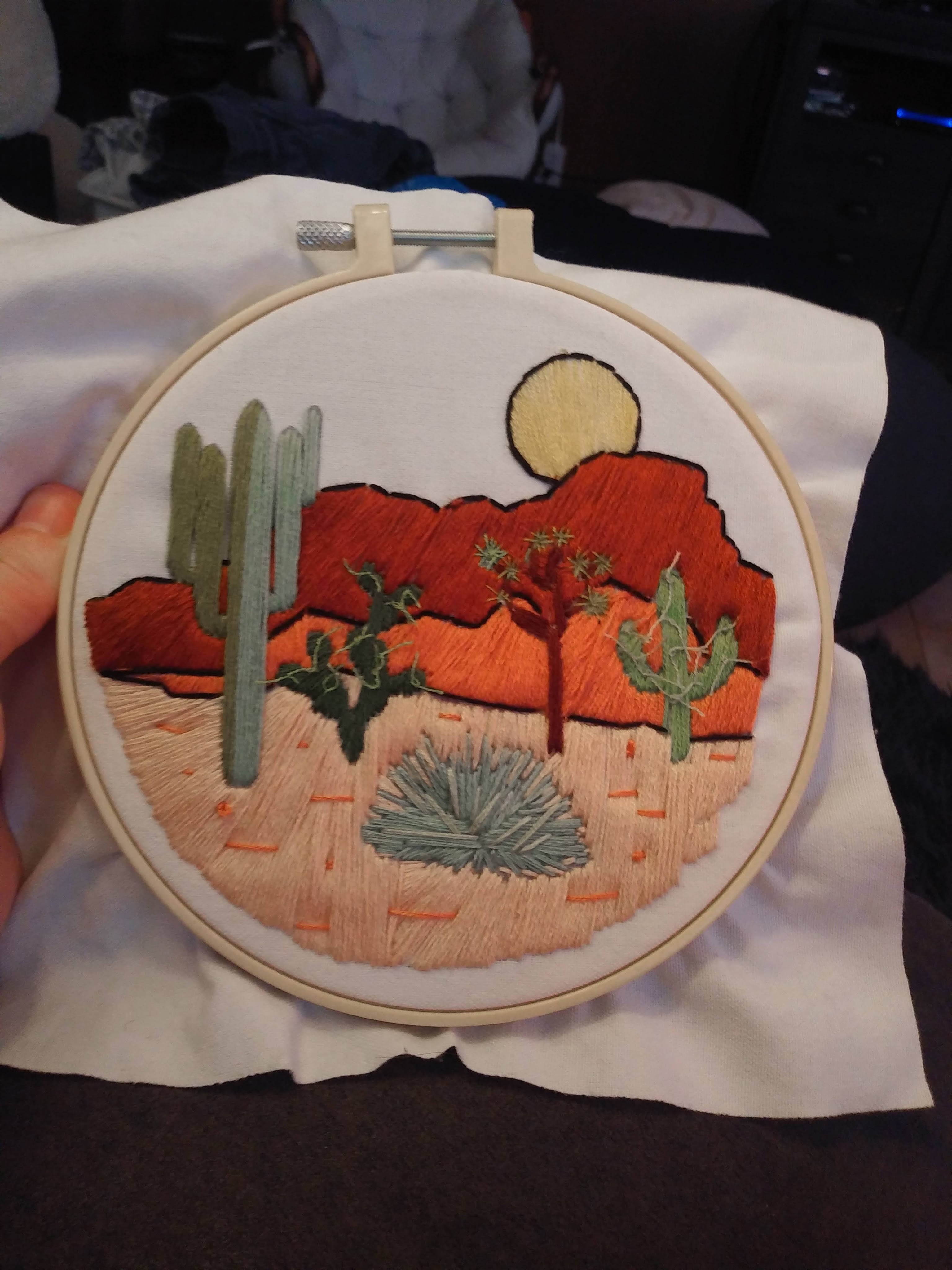
Photo of the Week: Learning to Embroider. This was my first embroidery project. It was a simple kit. I like it. It is imperfect–but unique. It was fun and makes me feel happy and accomplished when I see it. Next time, it will be a little easier.
This past weekend, I learned the basics of a type of therapy called EMDR (eye movement desensitization and reprocessing). (For more information on what EMDR is, look at https://www.emdria.org/.) Sometimes, when learning new things, I feel intimidated. I felt excited to learn this, but I could feel perfectionist tendencies creeping in. To combat that feeling, I decided to not say my fears out loud. That way, at least I would not hear my fears.
As the training went on, I felt a little overwhelmed by all the information. I recognized that is how I usually feel when learning new things. It is a familiar feeling. I decided to accept that was how I would feel for a while, trying to remember that, in the past, that feeling subsided and the information was integrated.
The information did become more integrated. As we practiced with each other, I felt as though my impulse to aim for perfection was getting in the way of authentic connection. So, I took some deep breaths and settled myself, remembering that in therapy, there is no “perfection.”
I will have to practice. What I know is that perfection is not the goal. There are different ways to do most things well. Including this type of therapy. Humans are varied, and so this technique will have some slight variation for each person. (Note: It is important if seeking an EMDR therapist, you find someone with professional training.)
I am learning. Growing. I want to deepen in authenticity and connection. That is the way I will help others to heal. That is what will help me heal as well. Technique does matter. It is important to know what aspects are most important and cannot vary, but also, which aspects can be unique.
What are you learning? How have you overcome perfectionist tendencies? I would love to hear from you!
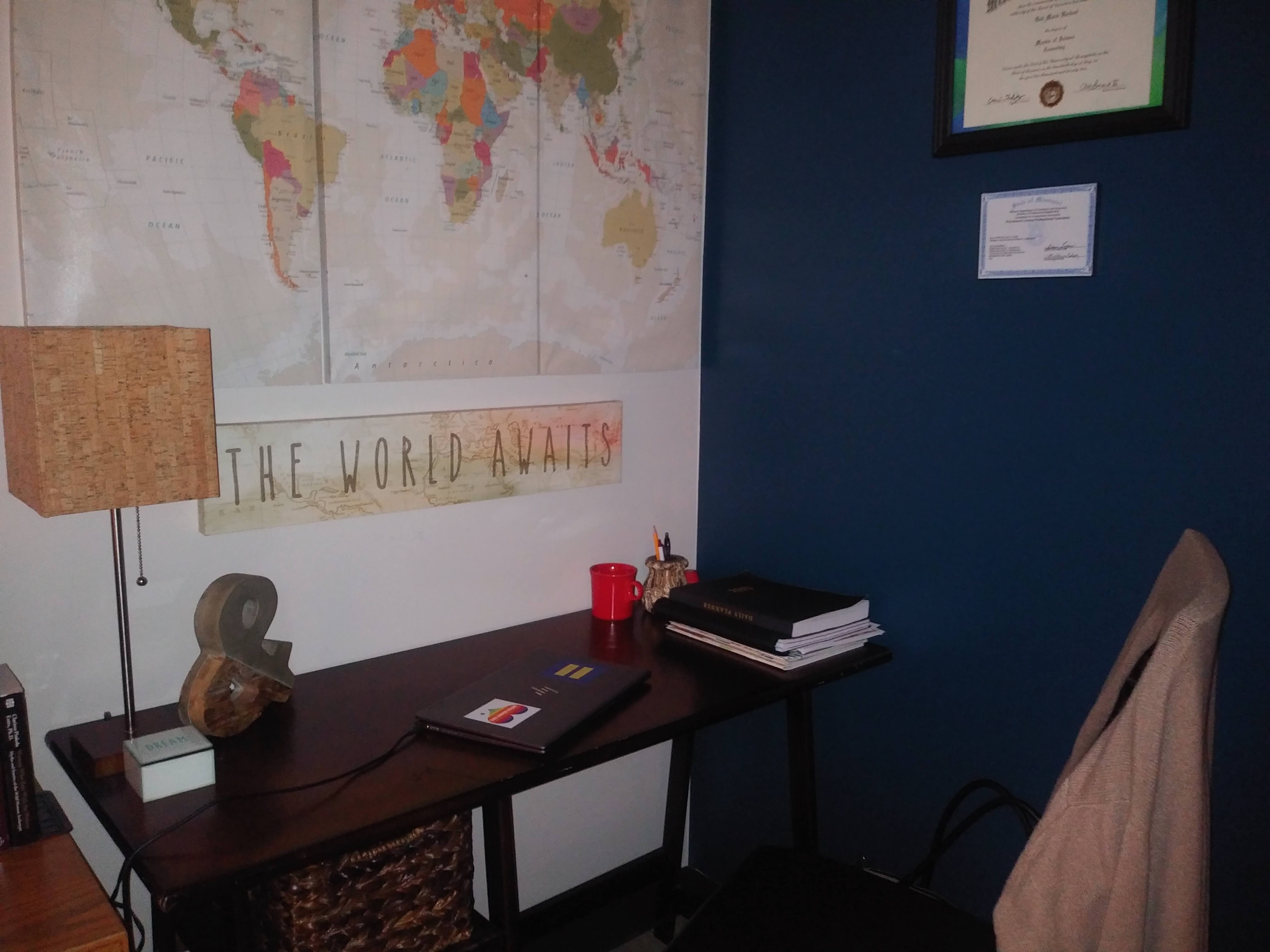
Photo of the Week: My desk. Decor shows others something about your identity. It reinforces to yourself who you are. What you surround yourself with impacts you and others.
I have a map and a quote “The world awaits.” This is to remind myself and my clients that the world is a big place, full of possibilities and perspectives. It is intended to be a reminder that we are not “stuck.” When we are ready, we can make a move to open our worlds.
The concrete and wood ampersand (&) is a reminder that we can simultaneously hold situations and emotions that seem to conflict. We can love and be scared. We can feel anger and hope. We can work in a difficult situation and be looking for something new. Again, a reminder of options.
These are things I look at every day when I am at work. These things remind me of my deeper meaning for what I do. I hope that they are reminders for my visitors as well.
What do you surround yourself with? What are your reminders?
Photo of the Week: “Sisters.” This figurine was a gift from my sister. She is seven years older than me. We have had times of contention, times of love. It is a bond unlike any other.
When I was little, she would play House and Barbies with me. She improved my dog costume for my preschool play by adding strings from the tail to my “paws” so I could make my tail wag. We shared a room and would play “hide-the-glowing-rosary” when we were supposed to be falling asleep.
She went away to college when I was entering sixth grade. It was agonizing for little Gail. My playmate and confidante was gone. These were the days of long-distance phone charges, so I did not speak with her often, though we did write letters.
As we grew older, we had different experiences–living in different places, husbands, children. Different opinions developed.
As the younger sister, I found that I viewed her as an authority in my life rather than as a peer. I found myself trying to live up to what I thought were her expectations, while going against my own expectations.
Eventually, the rift in our relationship grew larger. Neither of us felt emotionally safe with the other. We both felt like we were being judged. Our conversations were stilted, neither of us sharing our true selves.
But things have changed and now we are growing closer again. How? Through intention. We acknowledged that we love each other. That is the foundation. We definitely still have different opinions. However, we are choosing intentionally to see each other through the lens of love. This was an actual, concrete decision. We intentionally make time to visit each other–alone–every couple of weeks or so. We intentionally try to be honest about our thoughts and intentionally listen deeply–knowing the other is not a monster. It is hard sometimes. It is scary sometimes to be vulnerable. To be truthful. But both are required.
How have you worked toward healing a relationship? What has helped you?
Photo of the Week: Sunrise. Several years ago, I trained myself to be a morning person. For most of my life, I had a sense of dread when I woke. I felt an immediate surge of adrenaline, a feeling of “what am I already behind on?” or “what scary thing do I have to face today?” It was truly horrible.
At one point, I decided that I wanted time before I went to do the first dreaded thing. I thought that maybe if I had peaceful, maybe even happy, time before the thing, I would feel better. I thought maybe if the thing was a part of the day but not the first thing of the day, maybe it would seem less overwhelming. That is how it worked out for me.
The way I trained myself was that I decided to give myself two hours (!) before I had to leave my house. I went to bed eight hours before, which did give me an early bedtime (!). It was uncomfortable at first to lose late nights. I had been a night owl. Then I PACKED my morning with things I liked. I lit candles to make it cozy. I played gentle music I liked. I had coffee. I read or did other things I liked. Eventually, I added exercise. But, if you are trying this transition, at least at first only do things you enjoy. If you enjoy exercise then add it right away!
It really did not take long for the adjustment because I made the morning so nice. At this point, I wake up naturally by 5am. I go to bed around 9pm. I find that I wake at this time even if I do go to sleep later. I also let myself take a thirty minute nap sometime if possible. Sometimes I do afternoon tea or coffee.
The point is, if you are trying to make a change, try using gentleness and things that bring you joy. Maybe you want to add exercise, for example. Try doing something that feels good for exercise. Or if nothing feels good, try surrounding the exercise with things that bring you joy–good food, music, some activity that you do enjoy.
It seems simple. I find that many people I have known though, including myself, have tried to bully their way into a new habit. We have tried talking cruelly to ourselves, saying to “stop being lazy.” Or we have tried to be really strict so that a “failure” is met with self-punishment.
In social work, counseling, education, and other areas, there is a notion of “trauma-informed care.” Trauma-informed care is defined as practices that promote a culture of safety, empowerment, and healing. Life is hard. There are small difficulties, and sometimes large difficulties, in every day. Give yourself trauma-informed care. Be gentle and encouraging with yourself.
Even the attempt to heal an aspect of your life is a step. It is something to be celebrated. What is something you have done that was a struggle but worth it? How did you do it? What is something you are trying to change?
I used to think that, because healing is such an individual experience, there could be no “definition” of what it meant. When I read what Dr. Dan Siegel said about FACES (flexible, adaptive, cohesive, energized, stable), I changed my mind. To me, flexible, adaptive, cohesive, energized, and stable thinking/feeling, is thinking/feeling that is healthy. It is the ability to move with circumstances, the ability to experience your feelings while maintaining your sense of self.
I think it is a goal that is sometimes momentarily attainable, sometimes partially attainable, and sometimes out of reach.
When I work with a client, how this looks to them in their life is what is important. It seems that the goal a client sets is always some variation of FACES. “To feel joy;” “To not be so overtaken by depression;” “To grieve.” These are all requests to move through life gently, passionately, peacefully.
As a therapist, I see people–and I have experienced in my own life–approach the goal, back away from the goal, approach, back away, etc. I think this happens because healing can be scary for many reasons. Pain can become familiar. Pain can feel more stable, like there is nothing to lose, unlike with happiness. Pain can even allow us to stay in relationship with those who would not know how to relate to us if we changed. Pain can, in a way, be safe.
Healing is an ongoing process. Be compassionate with yourself. Reach out to others when you need to. Celebrate movement toward healing.
Several years ago, when I had finally gotten my first real, adult job, I set a financial goal. When I reached that goal, I thought, I would feel comfortable investing. After a time, I reached the goal! But I did not feel financially comfortable. So, I set another goal. When I reached it and still did not feel comfortable, it occurred to me that it was not about a financial amount. My anxiety was about something with deeper roots. There was never going to be a specific amount that made me “comfortable.”
I think that we do this same thing with relationships, with food, exercise, grades, and any number of other things! We set a “goal” that, if we reach it, we decide we will be satisfied. But satisfaction doesn’t happen. A breakthrough can happen, though, when we realize the deeper root cause of the anxiety.
How do we find the root cause(s)? There are different paths, but one way is by listening to the critical thoughts surrounding this type of anxiety. Is it the voice of a caregiver? Are the critical thoughts emphasizing a deep fear, like that you will always be alone, that you can’t care for yourself, or something else that you will “never” have or be able to do? Listen for extreme words, like “always,” and “never.”
What comes next? Challenging those thoughts and healing those wounds. This can take time and requires hard work. Journaling or talking with a friend or therapist can help. Be gentle with yourself while you do this work. You are worth the effort.



 Connections